


Small Kitchen, Big Ventilation Problem
It's a myth that a small kitchen needs less ventilation. In a compact galley or apartment kitchen, the cooktop is often inches from the dining table, the sofa, or the bed. Smoke, grease vapor and cooking odors have nowhere to dissipate — they settle on cabinets, cling to fabric, and linger long after dinner. If anything, a small kitchen needs better ventilation, not less.
The catch is space. You can't hang a 48-inch pro canopy over a two-burner apartment cooktop. What you need is the right small range hood: compact enough to fit, powerful enough to clear the air, and quiet enough to live beside. After two decades fitting ventilation into kitchens of every size, I can tell you the small-kitchen hood is one of the most satisfying problems to solve — because the right choice transforms how a tiny space feels to cook and live in.
This guide walks through every option that fits a small or apartment kitchen, and how to choose between them.

The Hood Types That Fit a Small Kitchen
Not every hood style suits a compact space. These are the four that do.
Under-cabinet hoods — the apartment default
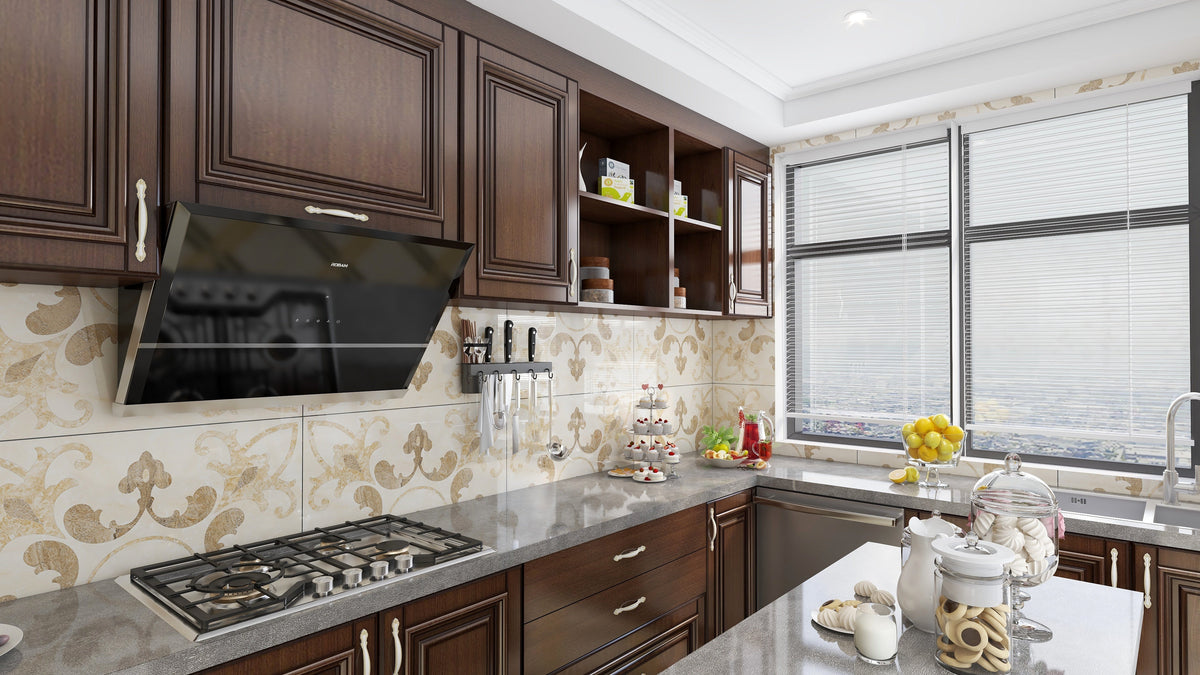
Mounted to the underside of a wall cabinet, the under cabinet vent hood is the most common choice in apartments and small kitchens. It uses space you already have, doesn't intrude into the room, and comes in both ducted and ductless versions. For most compact kitchens, this is where your search starts.
Low-profile / slim hoods — maximum clearance
When cabinets sit low or you want the hood to nearly disappear, a slim low-profile model only a few inches tall preserves headroom while still ventilating. Many of these are recirculating, making the low profile ductless range hood a natural fit for apartments where you can't run a duct outside.
Over-the-range microwaves — the space-saver
In the smallest kitchens, an over-the-range (OTR) microwave with a built-in fan combines two appliances in one slot — more on whether that's the right call below.
Compact wall or insert hoods
If your cooktop is on a wall with no cabinet above, a narrow wall-mounted or insert hood can still work in a small footprint, though under-cabinet remains the most common apartment solution.
Range Hood vs. Over-the-Range Microwave: Which for a Small Kitchen?
This is the defining decision for many apartment dwellers, because counter and cabinet space is at a premium. An OTR microwave saves a slot by combining microwave and ventilation — but there's a real trade-off in how well it ventilates.
The short version: a dedicated range hood almost always ventilates better. OTR microwaves typically have weaker fans, a smaller and higher capture area (the microwave body sits well above the cooktop), and many run as recirculating units that just filter and return air. A real hood sits at the right capture height, moves more air, and is built for one job: clearing smoke and grease.
The counterpoint is space and budget: if you genuinely cannot give up the cabinet slot or counter space for a separate microwave, an OTR combo is a reasonable compromise — just know you're trading ventilation performance for the space saving. For a full breakdown of the pros, cons and venting differences, see our dedicated comparison on what recirculating venting on a microwave really means before you decide.
My advice for anyone who cooks regularly: if you can fit a real hood, fit a real hood. Reserve the OTR combo for the tightest kitchens or the lightest cooks.
Ducted vs Ductless in an Apartment
In a rented or compact home, this often isn't a free choice — the building decides for you.
Ducted is always the performance ideal: it vents heat, humidity, grease and odors outside. If you own the home or have a route to an exterior wall, duct it.
Ductless (recirculating) is the reality for most apartments, where cutting through an exterior wall isn't allowed or possible. A recirculating hood filters air through a grease filter and a charcoal filter, then returns it to the room. It won't remove heat or humidity, and the carbon filters need periodic replacement — but modern recirculating hoods handle grease and odor far better than their reputation suggests. If venting outside isn't an option, don't settle for the cheapest unit; a quality recirculating model makes a real difference. Our roundup of the best ductless range hood choices is a good place to compare.
The rule for apartments: duct if the building allows it; otherwise buy a good recirculating hood and commit to filter changes.
One quiet advantage small kitchens enjoy here: because they rarely need the four-figure CFM that triggers make-up air requirements, you usually sidestep that whole complication. A compact kitchen running a sensibly-sized 300–450 CFM hood stays well under the 400 CFM threshold where make-up air typically becomes a code concern — one less thing to engineer, and one less cost. It's a reminder that in a small kitchen, modest and well-chosen almost always beats big and overbuilt.
Sizing: Why 30 Inches Is the Apartment Standard
Most apartment and small-kitchen cooktops are 30 inches wide, which makes the 30 inch range hood the default size — it aligns with standard cabinet widths and offers the widest selection of compact models. The sizing rule never changes, no matter how small the kitchen: the hood should be at least as wide as the cooktop. A hood narrower than the burners lets smoke escape off the edges, and in a small kitchen that smoke has nowhere to go.
If your cooktop is smaller — a 24-inch or two-burner apartment unit — look for a hood that matches or slightly exceeds its width. Never undersize to save a few inches; capture area is what makes a small hood effective.
Right-Sizing the Airflow (Without the Noise)
Here's where small-kitchen owners often get it wrong in both directions — buying a weak hood that can't clear the air, or an oversized one that's deafening in a tiny room.
The sizing guide: roughly 100 CFM per linear foot of cooktop for electric, 150 CFM per foot for gas. A 30-inch cooktop therefore needs only about 250–450 CFM for most cooking — a modest, achievable number. You don't need a 900 CFM monster in a studio apartment; you need enough airflow, captured well, running quietly.
Two small-kitchen-specific tips:
- Noise matters more in a small space. With the cooktop near your living area, a loud hood is a daily irritation. Choose a multi-speed model so you can run a quiet low speed for everyday cooking and only boost when frying. Look for sone ratings where published.
- Give ductless a little headroom. Recirculating hoods lose some effective airflow to the carbon filter, so if you're going ductless, don't buy right at the minimum — a bit of extra rated CFM compensates.
Material and Finish for Compact Kitchens
In a small kitchen, the hood is close to everything — the cooktop, the counter, often your eye line. A stainless steel range hood is the practical default: it resists grease and heat, wipes clean in seconds (important when it's at arm's reach), and visually recedes with a clean, neutral finish that makes a small space feel less cluttered. Stainless also pairs with the compact stainless appliances common in apartments, keeping the look cohesive.
A tidy, easy-clean finish genuinely matters more in a small kitchen, where every surface is visible and grease shows quickly.
Installation Tips for Rentals and Tight Spaces
- Check what you're allowed to change. In a rental, confirm with your landlord before any ducting or hardwiring. Recirculating, plug-in hoods are often the only permitted option — and that's fine.
- Measure the exact slot. Width between cabinets, height from cooktop to cabinet underside, and depth. A small kitchen has no room for a "close enough" fit.
- Plan the shortest duct run if you can vent — in a small kitchen the run to an exterior wall is often short, which actually helps airflow.
- Confirm the power source. Plug-in versus hardwired, and whether an outlet sits within reach inside the cabinet.
- Keep filters accessible. You'll clean grease filters often and swap carbon filters periodically; make sure you can reach them in a tight install.

Real-World Scenarios: Three Small Kitchens
The studio apartment. A two-burner 24-inch cooktop under a low cabinet, no exterior venting, light cooking. A slim low-profile ductless hood matched to the cooktop width, run quiet on low. It clears everyday steam and odor and disappears under the cabinet.
The rental galley. A 30-inch electric cooktop with cabinets above, landlord won't allow new ducting. A 30-inch recirculating under-cabinet hood with quality carbon filters, around 350–400 CFM. Easy to install, easy to live with, and genuinely effective with filter upkeep.
The owned condo with a short duct path. A 30-inch gas cooktop on a wall with an exterior wall just behind. Here you can — and should — duct: a 30-inch ducted under-cabinet hood at ~450 CFM, with a short, straight run outside. Best performance of the three.
The pattern: the building's venting options and your cooking style decide the hood, and the width always matches the cooktop.
Common Mistakes in Small Kitchens
- Assuming you don't need much ventilation. Small kitchens concentrate smoke and odor — you need capture, not less of it.
- Buying an undersized hood to fit a gap. Match the cooktop width; a narrow hood leaks smoke into your living space.
- Over-buying CFM. A 900 CFM hood in a studio is loud, may require make-up air, and offers no real benefit over a well-placed 400 CFM unit.
- Choosing an OTR microwave for the space saving, then regretting the weak ventilation. If you cook often, fit a real hood.
- Neglecting ductless filters. A saturated carbon filter is why people think recirculating "doesn't work." Replace on schedule.
Small-Kitchen Hood Options Compared
To make the choice concrete, here's how the main small-kitchen options stack up side by side.
| Option | Ventilation quality | Space used | Best for |
|---|---|---|---|
| Ducted under-cabinet | Best — removes heat, grease, odor outside | Cabinet underside; needs a duct route | Owned homes, short exterior-wall runs |
| Ductless under-cabinet | Good — filters grease & odor, keeps heat | Cabinet underside; no duct | Rentals and apartments with no venting |
| Low-profile ductless | Good — same filtering, slimmer body | Minimal; preserves headroom | Low cabinets, tight clearance |
| Over-the-range microwave | Fair — weaker fan, high capture point | Saves a cabinet/counter slot | Tiniest kitchens, light cooks |
Read across the table and the pattern is clear: ventilation quality drops as you prioritize space-saving over a dedicated hood. That's not a reason to avoid the space-savers — in the right kitchen they're exactly correct — but it's why you should match the choice to how much you actually cook. A heavy cook in a studio is better served by a real ductless under-cabinet hood than by an OTR microwave; a light cook who rarely fries can happily take the combo and reclaim the slot.
One more small-kitchen consideration that's easy to overlook: lighting and controls. In a compact kitchen the hood is right in front of you, so bright LED task lighting over the cooktop genuinely improves the cooking experience, and simple, reachable controls matter when the hood is at arm's length. These aren't headline specs, but in daily use at close quarters they shape how much you enjoy the kitchen. A well-lit, quiet, easy-to-wipe hood makes a small space feel considered rather than cramped — which is the whole goal.
Finally, think about resale and longevity. Apartments and starter homes change hands, and a clean, neutral stainless hood that's clearly well cared for reads as a quality kitchen. Spending a little more on a durable, quiet unit pays off both in daily living and when it's time to move on.
How to Choose: A Quick Decision Path
- Measure the slot. Width, height and depth between your cabinets — fit comes first in a small kitchen.
- Match the width to your cooktop. 30 inches for most apartments; smaller if your cooktop is smaller, never narrower.
- Decide ducted or ductless. Duct if the building allows; otherwise a quality recirculating model.
- Right-size CFM. ~100 (electric) or ~150 (gas) per cooktop foot — modest is fine, and quieter.
- Prioritize a quiet, multi-speed blower. Noise matters most when the kitchen is near your living space.
- Pick easy-clean stainless for a close-quarters, low-maintenance finish.
The Bottom Line
A small kitchen deserves real ventilation, and today there's a compact hood for every apartment constraint. Match the hood's width to your cooktop, duct it if your building allows and choose a good recirculating model if it doesn't, right-size the airflow so it's effective but quiet, and favor an easy-clean stainless finish. Weigh a dedicated hood against an over-the-range microwave honestly — if you cook regularly, the real small range hood wins on performance. Get these basics right and even the tightest kitchen stays clear of smoke, grease and odor — and a clear, fresh-smelling kitchen makes a small home feel dramatically more livable every single day.
Frequently Asked Questions
What's the best range hood for a small apartment kitchen?
For most apartments, a 30-inch under-cabinet hood matched to the cooktop — ducted if the building allows, or a quality recirculating (ductless) model if it doesn't. Prioritize a quiet, multi-speed blower and an easy-clean stainless finish.
Is a range hood or over-the-range microwave better in a small kitchen?
A dedicated range hood almost always ventilates better — stronger fan, better capture height. An OTR microwave saves space by combining two appliances but trades ventilation performance. If you cook often, choose the hood.
How many CFM do I need for a small kitchen?
Roughly 100 CFM per foot of cooktop for electric and 150 for gas, so a 30-inch cooktop needs only about 250–450 CFM. You don't need a huge number — and a smaller, well-placed hood is quieter.
Can I use a range hood in a rental with no outside vent?
Yes — a ductless (recirculating) hood filters and returns air with no external duct, which is ideal for rentals. Just replace the carbon filters on schedule to keep it effective.