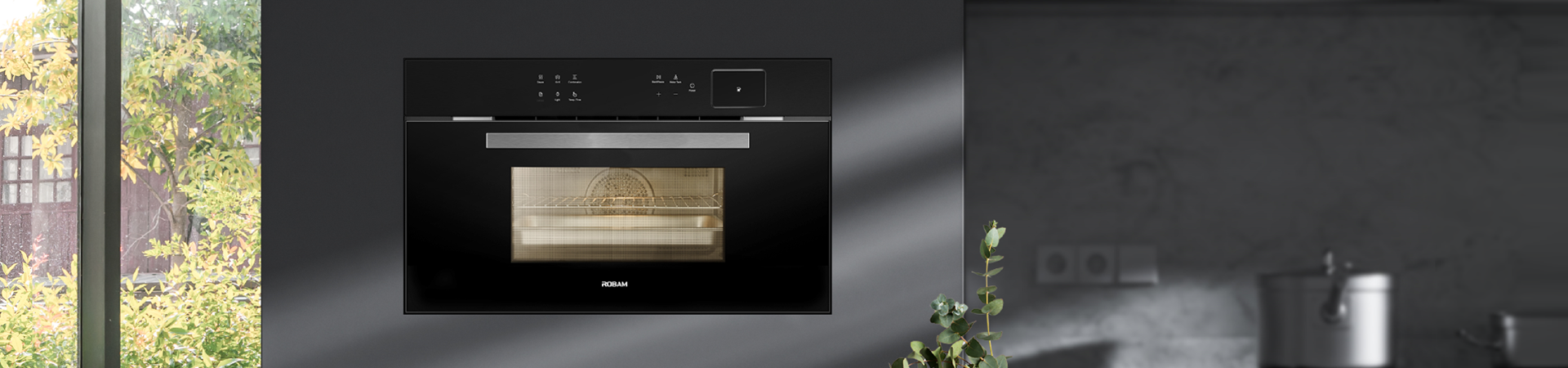



Cooking is one of the largest sources of indoor air pollution in the average home—second only to smoking. Every time you sear, fry, or stir-fry, you release an invisible mix of cooking pollutants: fine particles (PM2.5), ultrafine particles, nitrogen dioxide, volatile organic compounds, and grease aerosols. They don’t stay politely over the stove, either—they drift into every room and linger for hours. The single most effective everyday defense is capturing those pollutants at the source with a properly used range hood, before they ever reach your lungs or your living room.
That’s the core idea of this guide: ventilation isn’t a luxury feature, it’s the protection. A powerful range hood such as the auto-syncing ROBAM 86H1S pulls the rising plume off your cooktop and removes it—ideally outdoors—so the pollutants never get the chance to spread and settle. Below, we break down what’s actually in cooking pollution, why your cooking technique matters even more than whether you cook with gas or electric, and how to get the most protection out of your kitchen ventilation.

What’s actually in cooking pollution?
“Smoke” is shorthand for a complicated chemical mixture. The main cooking pollutants worth knowing about are:
- Fine particulate matter (PM2.5) — particles 2.5 micrometers and smaller that travel deep into the lungs and bloodstream. Cooking is a leading indoor source.
- Ultrafine particles (UFPs) — even smaller particles produced in huge numbers by high-heat, oil-based cooking. Roughly half of cooking PM2.5 can be smaller than 0.3 micrometers, which means inexpensive air-quality sensors often miss it entirely.
- Nitrogen dioxide (NO₂) — a respiratory irritant produced by the combustion of gas and propane burners.
- Volatile organic compounds (VOCs) and aldehydes — gases released as oils and food break down under heat, including acrolein and formaldehyde. High-heat frying generates the most.
- Polycyclic aromatic hydrocarbons (PAHs) and grease aerosols — heavier compounds and oily droplets that coat surfaces and cabinets and contribute to long-term buildup.
Researchers have linked long-term exposure to cooking emissions with respiratory and cardiovascular effects, which is why managing them day to day matters—not just on the occasions when the kitchen visibly fills with smoke.
It’s not just gas: technique matters more than fuel
It’s easy to assume cooking pollution is only a gas-stove problem. The flame does add nitrogen dioxide and combustion particles—but the cooking process itself is a major source no matter what you cook on. In one 2024 controlled-kitchen study that prepared the same dish with different methods, peak PM2.5 varied enormously by technique: pan-frying produced roughly 93 µg/m³, stir-frying about 27, deep-frying around 8, and boiling under 1 µg/m³. VOC levels followed the same pattern. The lesson is that how you cook—high heat and oil versus water—often drives exposure more than your choice of cooktop.
Switching to electric or induction helps with some pollutants but not all. Induction eliminates the NO₂ from combustion and tends to release fewer ultrafine particles—yet for the same meal it can produce comparable, sometimes even higher, PM2.5, because the food and oil are themselves the particle source. In short: whatever sits under your pan, the cooking still makes pollutants, so ventilation matters for every kitchen.
Why cooking pollutants become the whole home’s problem
Cooking pollution rarely stays in the kitchen. Measurements show that ultrafine particle levels in a room down the hall can climb to nearly match the kitchen’s within about ten minutes of cooking, and fine particles and gases can remain elevated for hours afterward in a closed-up home. The same research consistently finds the worst-case scenario is high-heat cooking with the range hood switched off—exactly when capture matters most. Run the hood, and you intercept the plume before it spreads to bedrooms, sofas, and the people not even in the kitchen.
How range hood ventilation protects your indoor air
A range hood protects you in two steps: it captures the rising plume over the cooktop, and—if ducted—it removes those pollutants from the building entirely. That source capture is far more effective than trying to clean the air after it has already mixed through your home, which is what a standalone air purifier in the next room is left to do.
The measured difference is significant. In a U.S. Department of Energy laboratory simulation, average PM2.5 in a small apartment cooking three meals a day was about 37 µg/m³ with no ventilation, but fell roughly by half—to around 17 µg/m³—with a moderately effective range hood running. Ventilation also cleared the air faster after cooking finished.
For pollutants beyond particles, filtration design matters too. ROBAM’s A832 under-cabinet hood pairs strong ducted extraction with a three-stage filtration system aimed at fumes, odors, and airborne VOCs—useful for the gaseous side of cooking pollution, not just the grease. And because the most common reason a hood fails to protect anyone is simply not being switched on, auto-sync features that start the fan the moment you begin cooking quietly close the biggest gap in real-world performance.
Getting the most protection from your range hood
- Cover the burners you use. Capture efficiency is highest when the hood extends over the cooking surface; back-burner emissions are captured far more effectively than front-burner ones, so cook toward the back when you can.
- Run it before, during, and after. Start the fan as you begin and leave it on 10–15 minutes after you finish to clear lingering gases and ultrafine particles.
- Match power to your cooking. Light simmering needs little; high-heat frying and wok cooking benefit from higher CFM and strong static pressure.
- Vent outdoors where possible. Ducted hoods physically remove pollutants from the home; recirculating hoods help with grease and odors but return filtered air to the room.
- Keep filters clean. Grease-clogged filters choke airflow and cut capture; wash baffle filters on schedule and replace charcoal filters as recommended.
If you can’t vent outdoors
Renters and apartment dwellers aren’t out of options. Studies show that even recirculating range hoods with proper filters substantially reduce cooking particle levels—far better than no ventilation at all. A purpose-built convertible hood such as ROBAM’s CleanAir Series combines strong airflow with air-purifier-grade charcoal filtration and can switch to ducted mode if your home allows it later. Pair it with back-burner cooking, an open window when practical, and a longer run time after cooking.
The bottom line
Cooking pollutants—PM2.5, ultrafine particles, NO₂, VOCs, and grease—are an everyday reality in every kitchen, gas or electric, and they spread well beyond the stove. The most effective protection isn’t reactive air cleaning; it’s capturing pollution at the source with a properly sized range hood, vented outdoors when possible and used every time you cook. Browse ROBAM’s under-cabinet range hood collection to find a model matched to your kitchen and cooking style.
Frequently asked questions
What pollutants does cooking produce?
Cooking releases fine particulate matter (PM2.5), ultrafine particles, volatile organic compounds and aldehydes, polycyclic aromatic hydrocarbons, and grease aerosols—plus nitrogen dioxide when you cook with gas or propane. High-heat, oil-based methods like frying produce the most.
Is cooking bad for indoor air even on an electric stove?
Yes. Electric and induction cooktops avoid combustion gases like NO₂, but the food and oil still generate particles and VOCs. For a given meal, PM2.5 can be similar regardless of cooktop, so ventilation is worthwhile in every kitchen.
Does a range hood actually remove cooking pollutants?
A ducted range hood captures the rising plume and removes pollutants from your home entirely, which is the most effective approach. Recirculating hoods filter and return the air, reducing grease, odors, and particles but not fully removing gases.
Is a range hood better than an air purifier for cooking pollution?
They do different jobs. A range hood captures pollutants at the source before they spread, while an air purifier cleans air after it has already mixed through the room. Source capture is more effective for cooking, though a purifier can complement it in open-plan spaces.
How long should I run the range hood?
Turn it on as you start cooking and leave it running for about 10–15 minutes afterward to clear lingering gases and ultrafine particles, which can stay airborne well after the food is done.
Figures in this article reflect peer-reviewed indoor-air research on cooking emissions (2022–2026), U.S. Department of Energy / Lawrence Berkeley National Laboratory ventilation simulations, and air-quality guidance from the U.S. EPA and WHO; results vary by cooking method, ingredients, and installation. ROBAM product details reflect published specifications—confirm specifics and current pricing on each product page. This article is for general educational purposes and is not medical advice.