


When There's Simply No Room for a Big Hood
Not every kitchen has the luxury of a soaring chimney canopy. Apartments, galley kitchens, homes with a window directly behind the cooktop, or cabinets that run low over the range all share one problem: there isn't enough vertical space for a statement hood. For years, that meant settling for a weak, builder-grade unit that pushed more noise than air.
That's no longer the case. The modern low profile ductless range hood — and its slim ducted cousins — have closed much of the performance gap. Done right, a hood only a few inches tall can capture smoke, grease and steam nearly as well as a full canopy, while disappearing neatly under a cabinet. The trick is knowing what to look for, because "slim" covers everything from genuinely engineered ventilation to hollow decoration.
After two decades specifying hoods for tight kitchens, I'll walk you through exactly how to choose a low-profile hood that actually works — and where the real trade-offs hide.
What Counts as a "Low-Profile" Range Hood?
"Low-profile" isn't a single product category; it's a family of slim designs built to live in limited space. The three you'll meet most often are:
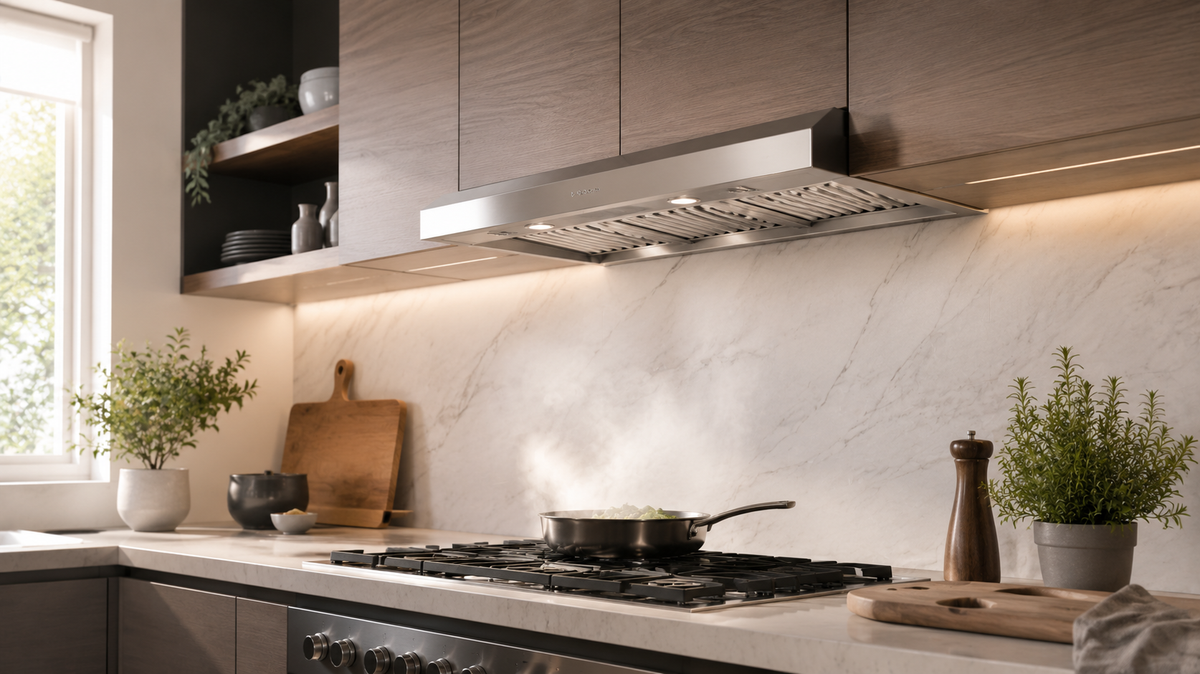
- Under-cabinet slim hoods. These mount to the underside of a wall cabinet, typically just 3–6 inches tall. They're the classic answer to low clearance and the most common low-profile choice.
- Built-in / insert hoods. The ventilation "guts" slide into a custom cabinet or a slim mantel, hiding almost entirely from view. The visible face is minimal.
- Slide-out and telescopic hoods. A pull-out visor extends over the cooktop when you cook and retracts flush when you don't — maximizing capture area without a permanent bulky profile.
What unites them is a shallow housing and a cooktop-level or near-cooktop capture plane. What varies — enormously — is the blower behind that slim face. A thin hood with a powerful, well-ducted blower performs; a thin hood with a token fan does not. Height tells you about fit, not about function.
Why Clearance and Mounting Height Matter First
Before you shop features, settle the single most important number: how high the hood sits above your cooktop. Mount it too high and the rising plume spreads before the hood can grab it; mount it too low and you risk heat damage, code violations, and banging your head.
General guidance puts a hood 24–30 inches above an electric cooktop and 24–36 inches above gas, but always follow the manufacturer's spec and local code — gas ranges in particular have strict minimums for fire safety. In a low-clearance kitchen, every inch is contested, which is exactly why slim housings exist: they let you keep the capture face at the right height even when cabinets are low. For the full breakdown of measuring and setting this, see our range hood height install guide before you commit to a model.
Get this wrong and even a brilliant hood underperforms. Get it right and a modest slim hood can punch well above its size.
Ducted vs Ductless: The Defining Choice for Slim Hoods
This is the fork in the road for low-profile buyers, and it deserves real thought.
Ducted (vented) slim hoods
A ducted hood pushes air outside through ductwork. It's the gold standard: it truly removes heat, humidity, grease-laden air and combustion by-products from the home. If your low-profile hood can be ducted — even through a short wall run or a soffit — do it. Slim under-cabinet hoods duct readily either through the back wall or up through the cabinet.
Ductless (recirculating) slim hoods
A ductless hood pulls air through a grease filter and a charcoal (carbon) filter, then returns the cleaned air to the kitchen. No external duct is required, which is why it's the default for apartments, interior walls, and condos where venting outside is impossible or prohibited.
The honest trade-off: recirculating hoods don't remove heat or humidity, and the carbon filters need periodic replacement to keep working. But today's best units are genuinely effective at knocking down grease and odor — a world away from the rattly units of a decade ago. If venting isn't an option, a quality low profile ductless range hood is a legitimate, not a consolation, choice. To see how far the category has come and which models lead, our roundup of the best ductless range hood options is a useful next read.
The decision rule is simple: duct if you can, recirculate if you can't — and if you must recirculate, buy quality and commit to filter changes.
The Under-Cabinet Form Factor: Workhorse of Low Clearance
For most low-clearance kitchens, the slim under cabinet vent hood is the natural fit. It uses space you already have — the underside of an existing wall cabinet — rather than demanding a tall open wall. Benefits that matter in a tight kitchen:
- Space efficiency. No freestanding canopy intruding into the room or sightlines.
- Flexible venting. Duct out the back wall, or up and out through the cabinet; or run ductless where needed.
- Clean aesthetics. The hood reads as part of the cabinetry rather than a separate appliance.
- Budget range. Under-cabinet hoods span entry-level to premium, so there's a fit for most projects.
Explore the full span of slim options in our under cabinet vent hood collection, which includes both ducted and recirculating designs sized for standard cabinets.
The one caution: because the housing is shallow, the blower and filter area are smaller than a big canopy's. That makes capture area and blower quality the specs to scrutinize — more on that below.
Getting Real Performance from a Slim Housing
A low profile doesn't have to mean low performance, but you have to read past the headline CFM number. Here's what separates a slim hood that works from one that just hums.
Right-size the airflow, don't over-chase it
Match CFM to your cooking, not to the biggest number on the shelf. A rough guide: about 100 CFM per linear foot of cooktop for electric and 150 CFM per foot for gas. A slim hood over a standard cooktop with moderate cooking rarely needs four-figure airflow; a well-captured 400–600 CFM beats a poorly-positioned 900. (Note that recirculating hoods lose some effective airflow to the carbon filter, so give ductless models a little headroom.)
Capture area beats raw power
A slim hood that's as wide as — or wider than — your cooktop captures the plume before it escapes. A hood narrower than the cooktop leaks smoke off the edges no matter the fan rating. Telescopic and slide-out designs shine here: they temporarily enlarge the capture face without a permanently bulky body.
Filters: baffle, mesh, and carbon
Ducted slim hoods use aluminum mesh or baffle grease filters that you wash. Ductless hoods add a carbon filter that adsorbs odor and must be replaced on a schedule (often every 3–6 months with regular cooking). Dirty filters are the number-one reason a low-profile hood "stops working" — keep them clean and the hood keeps performing.
Noise
Slim hoods can be surprisingly loud if the blower is cheap, because there's little housing to dampen sound. Look for a multi-speed motor so you can run a quiet low speed day to day and reserve full power for heavy cooking. Sone ratings, where published, help you compare.
Size and Fit: Why 30 Inches Is the Sweet Spot
Most cooktops in apartments and standard kitchens are 30 inches wide, which makes the 30-inch hood the most common — and most versatile — low-profile size. It aligns with typical cabinet widths, suits the kitchens that most often face clearance limits, and comes in the widest selection of both ducted and ductless slim models. If your cooktop is 30 inches, start your search in our 30 inch range hood collection and size the hood to match — equal to or slightly wider than the cooktop for best capture.
Going to 36 inches? The same principles apply; you'll simply want proportionally more airflow and a correspondingly wider capture face.
Material and Finish: Why Stainless Steel Wins Near a Stove
In a slim hood mounted close to the cooktop, the housing takes a beating from heat, steam and airborne grease. That's why a stainless steel range hood is the practical default: it resists staining and corrosion, wipes clean with minimal effort, and holds its finish far better than painted surfaces in the splash zone. For low-profile hoods especially — where the underside sits inches from your pans — an easy-clean stainless face saves real maintenance headaches over the years. It also reads as a clean, neutral design that blends with virtually any cabinetry.
Installation Tips for Tight Spaces
- Measure the gap first. Confirm the vertical distance from cooktop to the cabinet underside, then check it against the hood's required mounting height. This decides whether a slim hood even fits.
- Plan the duct path early. For ducted installs, the shortest, straightest run with smooth-wall duct preserves the most airflow. Every elbow costs you.
- Mind the window. If a window sits behind the cooktop, a slim under-cabinet or a telescopic hood often clears it where a canopy can't.
- Check electrical. Confirm whether the hood hardwires or plugs in, and that an outlet or junction box is reachable within the cabinet.
- Budget filter access. You'll remove grease filters often and carbon filters periodically — make sure both are easy to reach once installed.
Who Should Buy a Low-Profile Hood?
A slim or low profile ductless range hood is the right call if you:
- Have low cabinets or limited clearance above the cooktop.
- Live in an apartment or condo where exterior venting is restricted — recirculating is your friend here.
- Have a window or design feature directly behind the range that rules out a tall canopy.
- Want a minimalist look where the hood recedes into the cabinetry.
- Do light-to-moderate cooking and don't need commercial-grade extraction.
If instead you run a high-BTU pro range, do daily high-heat wok cooking, or have an open-concept great room, a taller ducted canopy will serve you better — slim hoods trade some capacity for fit.
Real-World Scenarios: Three Tight Kitchens
Advice lands better against real layouts. Here are three low-clearance kitchens and how I'd solve each.
The rental apartment with no exterior venting. A 30-inch electric cooktop under a low cabinet, no way to duct outside, light-to-moderate daily cooking. This is the textbook case for a quality low profile ductless range hood: a slim under-cabinet model with a good grease filter and a replaceable carbon filter. It won't remove heat, but it'll keep grease and odor in check — and nothing needs to be cut through an exterior wall.
The condo with a window behind the range. A 30-inch gas cooktop with a window just above and behind it, cabinets flanking both sides. A full canopy would block the glass. A telescopic or slim under-cabinet hood sits below the window line, ducts out through the side wall, and preserves the view and the daylight. Capture area matters most here, so a model as wide as the cooktop is non-negotiable.
The galley kitchen with a soffit. A narrow 36-inch run with a bulkhead above the cabinets. A built-in insert tucked into a slim custom surround ducts up into the soffit and vents out the roof — nearly invisible, fully ducted, and quiet on low speed for everyday use.
Three different constraints, three different slim hoods — but the same method each time: fit first, vent if you can, size the capture face to the cooktop.
Common Mistakes in Low-Clearance Kitchens
- Mounting too high to "gain headroom." Raising a slim hood above its spec kills capture. Keep it at the correct height even when space is tight — that's the whole point of a slim body.
- Buying ductless, then never changing the carbon filter. A saturated filter is why people think recirculating "doesn't work." Set a reminder and swap on schedule.
- Choosing a hood narrower than the cooktop to fit between cabinets. Smoke escapes the edges; match or exceed the cooktop width instead.
- Chasing a huge CFM number in a thin housing that can't move that air quietly — you get noise, not performance.
- Ignoring filter access until after install, then struggling to reach the grease filter behind a low cabinet lip.
Sidestep these five and your slim hood will quietly outperform most buyers' expectations.
How to Choose: A Quick Decision Path
- Measure your clearance. Cooktop-to-cabinet gap versus the hood's required mount height. Fit comes first.
- Decide ducted or ductless. Can you vent outside? Duct. If not, choose a quality recirculating model and plan for carbon-filter swaps.
- Match the width. Equal to or wider than your cooktop — 30 inches for most kitchens.
- Right-size CFM. Roughly 100 (electric) or 150 (gas) CFM per cooktop foot, with a little extra for ductless.
- Prioritize capture area and a multi-speed, quiet blower. These matter more than a big peak number in a slim housing.
- Pick easy-clean stainless for durability close to the cooktop.
The Bottom Line
Low clearance is a constraint, not a dead end. The modern low-profile hood — whether a ducted slim under-cabinet model or a well-made low profile ductless range hood — delivers genuine ventilation in kitchens that can't host a big canopy. Nail the mounting height, choose ducted when you can, right-size the airflow, and favor capture area and a quiet multi-speed blower over a headline CFM figure. Do that, and a hood just a few inches tall will keep your compact kitchen clear of smoke, grease and odor for years.
Frequently Asked Questions
Do low-profile ductless hoods actually work?
Yes, when you buy quality and maintain the filters. They won't remove heat or humidity like a ducted hood, but today's best recirculating models knock down grease and odor effectively — and they're often the only option where venting outside isn't possible.
How often do I replace the carbon filter?
Typically every 3–6 months with regular cooking, though it depends on how much and how heavily you cook. Mark a reminder; a saturated carbon filter stops removing odor.
How high should a low-profile hood be mounted?
Follow the manufacturer's spec — generally 24–30 inches above electric and 24–36 inches above gas cooktops, subject to local code. See our height guide for exact measuring steps.
Is a 30-inch slim hood enough for a 30-inch cooktop?
It's the minimum match. Equal width works; slightly wider captures even better. Never go narrower than your cooktop.