


The Hood That Doubles as a Design Statement
Most range hoods are meant to disappear. A chimney-style hood does the opposite — it stands proudly on the wall as a focal point, its polished canopy and tapering flue cover anchoring the whole kitchen. If you've admired the clean, pro-kitchen look of a wall-mounted canopy and wondered whether a chimney hood is right for you, this guide is the answer.
After two decades specifying ventilation for kitchens of every size, I can tell you the chimney hood is one of the few appliances that has to perform and look the part. Get the sizing, venting and finish right and it becomes the best-looking, hardest-working feature in the room. Get them wrong and you've mounted an expensive mismatch at eye level. Let's make sure it's the former.

What Exactly Is a Chimney-Style Range Hood?
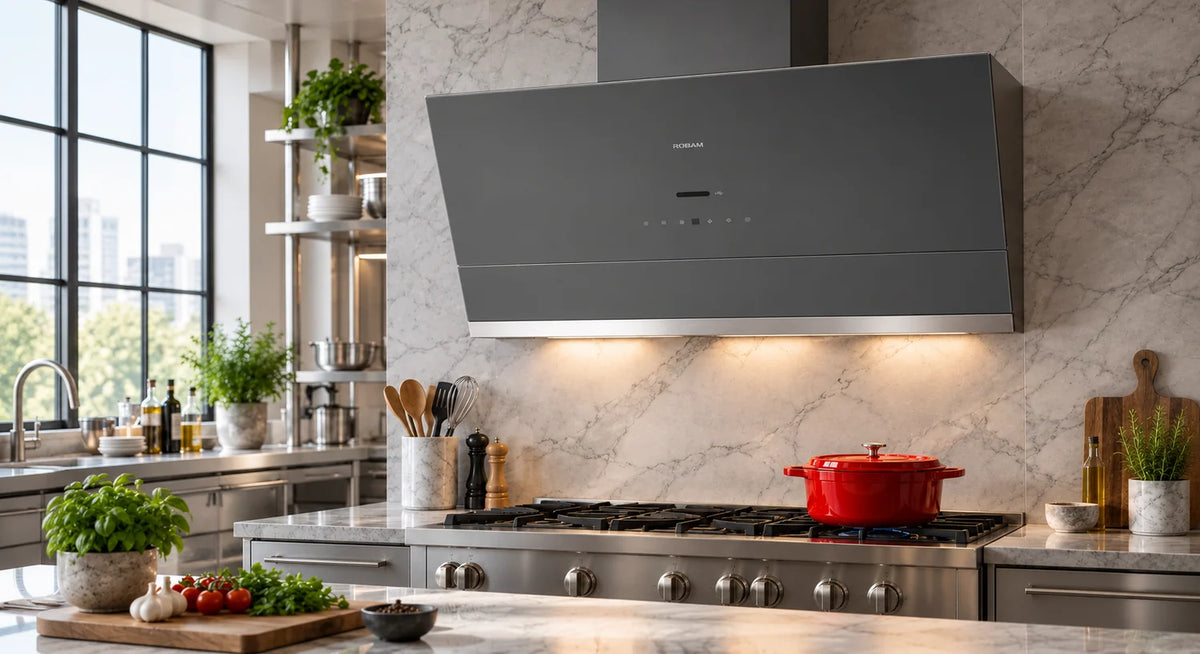
A chimney-style hood is a wall-mounted canopy hood with a decorative "chimney" — a flue cover that conceals the ductwork running from the canopy up to the ceiling. It has two visible parts:
- The canopy — the wide, angled or curved hood body that sits over your cooktop and captures the rising plume.
- The chimney (flue cover) — the tapering stack above the canopy that hides the duct and telescopes to fit your ceiling height.
That exposed, architectural form is the whole point. Unlike an under-cabinet hood that tucks away, or an insert that hides inside cabinetry, a chimney hood is designed to be seen. It typically mounts on an open wall behind the cooktop, with no cabinet above it — which is exactly what gives the kitchen that open, airy, professional feel.
Because it's wall-mounted, it belongs to the broader family of wall mounted range hoods, the category you'll want to browse if an against-the-wall cooktop is your layout.
Why Choose a Chimney Hood? The Real Advantages
A chimney hood isn't just about looks — the form brings genuine functional benefits:
- Large capture area. The wide canopy sits fully over the cooktop and often extends beyond it, grabbing the plume before it can escape sideways. More capture area means better real-world extraction at lower, quieter fan speeds.
- No cabinet heat exposure. With open wall above instead of a cabinet, there's no woodwork absorbing grease and heat right over your burners.
- Strong, accessible ducting. The vertical flue gives a clean, short path straight up and out — the ideal duct geometry for preserving airflow.
- A design anchor. It visually defines the cooking zone and lets you open up the wall with no upper cabinets, making even a modest kitchen feel larger.
The trade-off is commitment: because it's a feature, not a hidden utility, you need the wall space, the right proportions, and a finish that works with your cabinetry. That's what the rest of this guide covers.
Sizing: Match the Canopy to Your Cooktop
The single most important rule: the hood should be at least as wide as your cooktop — ideally wider. A canopy narrower than the burners lets smoke slip off the edges no matter how powerful the fan.
The two most common widths are 30 and 36 inches:
- 30-inch chimney hoods suit standard 30-inch cooktops and tighter walls.
- 36-inch chimney hoods are the sweet spot for 36-inch ranges and anyone who wants extra edge-to-edge capture. For a 30-inch cooktop, stepping up to a 36 inch vent hood gives you a margin of overhang that noticeably improves capture — a trick pro kitchens use constantly.
As a rule of thumb, aim for a canopy 3–6 inches wider than the cooktop on each side where the wall allows. And don't forget mounting height: most wall canopies sit 24–30 inches above an electric cooktop and 28–36 inches above gas — follow the manufacturer's spec so capture stays strong without exposing the hood to excess heat.
Power and Airflow: Sizing the CFM
A beautiful canopy still has to move air. Size the blower to your cooking:
- Electric cooktops: roughly 100 CFM per linear foot of cooktop width.
- Gas cooktops: roughly 150 CFM per foot, because gas adds combustion heat and by-products on top of cooking vapors.
A 36-inch gas cooktop therefore wants around 450–600 CFM at minimum, and more if you sear, wok or fry heavily. Gas cooking in particular deserves careful hood selection — not just for grease, but for removing combustion by-products safely. If you cook on gas, our dedicated guide to choosing a range hood for a gas stove covers the airflow and safety math in detail.
One reassurance: because a chimney hood's wide canopy captures so efficiently, you often don't need to chase the biggest CFM number. A well-proportioned canopy at a moderate speed outperforms a small, underhung hood running flat out — and it does so far more quietly.

Ducted vs Ductless Chimney Hoods
Chimney hoods are built around that vertical flue, which makes them natural candidates for ducted installation — the gold standard that vents heat, humidity, grease and combustion gases outside. If you have an exterior wall or a route up through the ceiling, duct it. The flue cover is literally designed to hide that vertical run.
A ductless (recirculating) configuration is possible on many chimney models using charcoal filters, for kitchens where outside venting isn't feasible. It's a legitimate fallback, but know the trade-off: recirculating returns filtered air to the room and doesn't remove heat or humidity, and the carbon filters need periodic replacement. Given that a chimney hood's whole advantage is that clean vertical duct path, duct it whenever you can — you'll get the full benefit of the design.
Finish and Material: Stainless vs Black (and Beyond)
Because a chimney hood is on permanent display, finish matters as much as function. Two choices dominate.
Stainless steel — the timeless default
A stainless steel range hood is the classic chimney-hood look: bright, professional, and endlessly compatible with other appliances. Practically, stainless resists heat and corrosion, wipes clean easily, and holds its finish in the splash-and-steam zone far better than paint. It's the safe, resale-friendly choice that suits almost any kitchen.
Black — the modern statement
If your kitchen leans contemporary, moody or high-contrast, a black range hood turns the chimney into a bold architectural feature. Black pairs beautifully with matte cabinetry, dark backsplashes and mixed-metal hardware, and it hides fingerprints and light grease marks better than bright stainless. It's the choice when you want the hood to be a deliberate design moment rather than a neutral appliance.
Whichever you choose, match the hood's finish to your dominant metal and appliance family so the canopy reads as intentional — not as an afterthought bolted to the wall.
Installation: What Makes or Breaks a Chimney Hood
A chimney hood is more involved to install than a slide-in under-cabinet unit, and the details decide both safety and performance. The essentials:
- Secure wall mounting. The canopy and flue carry real weight and must anchor into studs or proper blocking — never into drywall alone.
- Correct mounting height. Too high and capture suffers; too low and you risk heat damage and head-knocks. Follow the spec for your fuel type.
- Short, straight duct run. Route the duct straight up through the flue with smooth-wall duct and minimal elbows; every bend and every foot of flex steals airflow.
- Adjustable flue for ceiling height. Chimney covers telescope, but confirm the model's range covers your ceiling — standard, 9-foot, or vaulted.
- Make-up air for high CFM. In the U.S., hoods moving more than 400 CFM typically require a make-up air system by code; confirm with your installer before you buy.
Because of these steps, a chimney hood is usually a job for a qualified installer rather than a quick DIY swap. For a full walkthrough of the venting and mounting process, see our guide on how to install a rangehood before you schedule the work.
Noise, Lighting and Everyday Use
Two more factors shape how much you'll enjoy the hood day to day:
- Noise. Larger canopies capture efficiently at lower speeds, so a chimney hood with a multi-speed blower lets you run quiet for everyday simmering and boost only for searing or frying. Look for sone ratings where published.
- Lighting. Most chimney hoods include task lighting over the cooktop — a genuinely useful feature for a cooking zone with no cabinet (and no under-cabinet lights) above it. LED lighting is standard on quality models.
Maintenance is straightforward: wash the grease filters regularly (dishwasher-safe baffle or mesh filters make this painless), wipe the canopy down, and — if recirculating — replace carbon filters on schedule.
Real-World Scenarios: Three Kitchens
The open-plan showpiece. A 36-inch gas range on an open wall with no upper cabinets, in a kitchen that flows into the living room. A 36-inch stainless chimney hood, ducted straight up, at ~600 CFM. It anchors the cooking zone, keeps odors out of the living space, and looks the part from the sofa.
The dark, modern galley. A 30-inch cooktop against the wall in a contemporary kitchen with matte-black cabinets. A black chimney hood turns the required ventilation into the room's signature feature, hides fingerprints, and ties the hardware together.
The renovation with no exterior duct. A 36-inch cooktop on an interior wall where outside venting is impractical. A recirculating chimney hood with carbon filters keeps the architectural look while handling grease and odor — with a commitment to regular filter changes.
The common thread: the layout and cooking style write the spec, and the finish follows the kitchen's design language.
Common Mistakes to Avoid
- Undersizing the canopy. A hood no wider than the cooktop leaks smoke off the edges. Match or exceed the cooktop width.
- Ignoring ceiling height. Buying a flue cover that can't extend to a 9-foot or vaulted ceiling leaves an ugly gap — check the telescoping range first.
- Chasing peak CFM over capture. A big canopy at moderate speed beats a small hood at full roar, with far less noise and no make-up air headache.
- Forgetting make-up air. Above 400 CFM it's often code-required; plan for it before purchase.
- Mismatched finish. A bright stainless hood in an all-black kitchen (or vice versa) reads as an accident. Match the dominant metal.
Chimney Hood vs Other Hood Types
To see where a chimney hood fits, it helps to compare it against the alternatives you're likely weighing.
| Hood type | Where it mounts | Best for | Trade-off |
|---|---|---|---|
| Chimney (wall canopy) | Open wall, no cabinet above | Statement kitchens, open plans, strong vertical ducting | Needs wall space and the right proportions |
| Under-cabinet | Beneath a wall cabinet | Compact kitchens, keeping cabinet storage above | Smaller capture area, less visual impact |
| Insert / built-in | Hidden inside custom cabinetry or a mantel | A fully custom, concealed look | Requires cabinetry work; hood itself is invisible |
| Island | Suspended from the ceiling over an island | Island cooktops with no wall behind | Needs more CFM; harder, costlier install |
The chimney hood's niche is clear: it's the choice when your cooktop sits against a wall and you want the hood to be seen. If you'd rather keep cabinet storage above the range, an under-cabinet model makes more sense; if your cooktop is on an island, you're in island-hood territory instead. But for the classic against-the-wall layout where design matters, nothing else delivers the same blend of capture, clean ducting and architectural presence.
A quick note on budget and value: because a chimney hood is a visible, built-to-last feature, it's worth investing in solid construction and a quality multi-speed blower. This is not the appliance to cut corners on — you'll look at it every day, and a well-made canopy will still perform and look sharp a decade from now. The finish, the weld quality on a stainless body, the smoothness of the controls, and the brightness of the LED lighting all add up to how premium the hood feels in daily use.
How to Choose: A Quick Decision Path
- Confirm the layout. Chimney hoods need an open wall behind the cooktop with no cabinet above. If that's your kitchen, you're a candidate.
- Size the canopy. Equal to or wider than the cooktop — 36 inches for a 36-inch range, and consider 36 even over a 30-inch cooktop for extra capture.
- Right-size CFM. ~100 (electric) or ~150 (gas) CFM per cooktop foot; don't over-chase the number.
- Duct if you can. Use the vertical flue for a short, straight run outside; recirculate only if venting is impossible.
- Pick the finish. Stainless for timeless and resale-safe; black for a modern statement — matched to your dominant metal.
- Plan the install. Stud mounting, correct height, make-up air if over 400 CFM, and a qualified installer.
The Bottom Line
A chimney-style range hood is where performance and design meet. Its wide wall-mounted canopy captures smoke and grease efficiently — often more quietly than smaller hoods — while its flue cover turns necessary ductwork into an architectural feature. Size the canopy to your cooktop, duct it straight up whenever possible, choose stainless or black to suit your kitchen's character, and respect the installation details. Do that, and your chimney hood will be the rare appliance that works as hard as it looks good — for many years.
Frequently Asked Questions
What is a chimney-style range hood?
It's a wall-mounted canopy hood with a decorative flue cover that conceals the ductwork from the hood up to the ceiling. It mounts on an open wall with no cabinet above, making it both a ventilation appliance and a design feature.
Do chimney hoods have to be ducted?
No, many can run ductless with carbon filters, but ducted is strongly preferred. The vertical flue is built to hide a clean duct run, and ducting removes heat, humidity and combustion gases that recirculating can't.
What size chimney hood do I need?
At least as wide as your cooktop, ideally wider. Thirty- and 36-inch are the common sizes; a 36-inch hood over a 30-inch cooktop improves edge capture.
Stainless or black — which should I choose?
Stainless is timeless, resale-friendly and matches most appliances; black is a bold modern statement that hides fingerprints and suits dark, contemporary kitchens. Match whichever to your dominant metal and cabinetry.